Lomzurel
Flux Guide
Flux Guide
Couldn't load pickup availability
1. Problem Statement
After working with classes, objects, lists, and functions, a learner often begins to notice that code can behave differently than expected, even when the syntax looks correct. This is especially true in situations where a value may be missing, change in different places, or pass through several checks before reaching a result. Without a clear structure, null values, mistakes, unusual cases, and state changes can create confusion. Difficulty also appears when study examples become longer: the learner sees classes, lists, functions, and conditions together, but not always which part has which task. At this stage, learners need a tier that helps them read the flow of logic carefully, separate behavior variants, and work with data in a more orderly way.
2. Solution
Flux Guide is created for studying Kotlin through the idea of data movement: a value enters code, passes through checks, may change, may be missing, may be handled by functions, and returns in a readable form. The materials explain how to work with null values, how to reduce confusion during checks, how to read unusual situations, and how to place responsibility between code parts more clearly. This tier also introduces data classes, value copying, simple state models, and rewriting exercises. Each module is arranged so the learner does not only see a finished example but examines the path of a value from beginning to end. Because of this, the study process becomes more focused on logic, sequence, and the meaning of each action.
3. What’s Inside
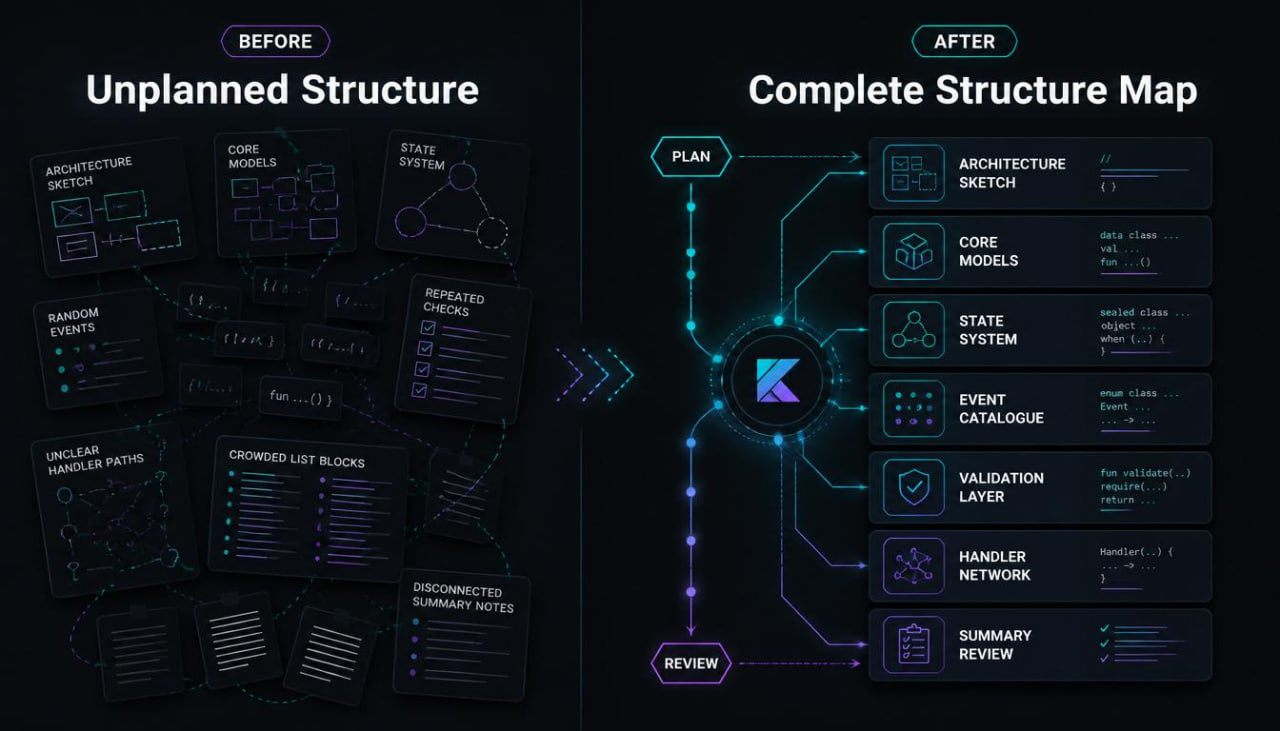
Flux Map: The Route of Data Movement
The opening module explains the main idea of the tier: data in code rarely stands still. It is passed into functions, checked, changed, placed into classes, moved through lists, and may have different states. The learner meets the scheme “input value → check → handling → result → self-review.” This section helps show the connection between earlier topics: variables, conditions, functions, lists, and classes. It also includes short notes on reading a longer Kotlin fragment: first find the data, then the checks, then the places where changes happen, and only after that the final result.
Null Notes: Working with Missing Values
One of the main blocks of the tier is devoted to null values. The learner studies why a value may sometimes be missing, how this is shown in code, and why this situation needs careful handling. The materials explain the difference between a value that is definitely present and a value that may be missing. Examples are based on simple study models: an optional description, an empty field, a missing search result, or a missing element in a group. Tasks ask the learner to check a value before using it, prepare a fallback variant, rewrite a condition, or explain why a fragment may work incorrectly.
Check Flow: Careful Checks Without Chaos
This module covers how to build checks so they do not turn into a long and uncomfortable block. The learner works with conditions that check text, numbers, object state, or value presence. The explanations show why the order of checks matters, how an early return can make a fragment easier to read, and how not to repeat the same checks. Exercises include examples with several behavior variants: check an empty value, reject an incorrect format, prepare a message, or pass data further. The learner practices seeing a logical route, not just a group of conditions.
Data Class Workshop: Data Classes in Study Models
This block introduces data classes as a way to describe study entities with several properties. The learner reviews examples of a task card, module record, compact profile, list element, or study note. The materials explain how a data class helps keep related values in an orderly form, how to read properties, and how to create several objects of the same type. A separate section covers copying with a small change: for example, when there is a record with one state and a similar record with an updated marker is needed. Tasks help learners create their own data classes, change properties, and explain why this structure is clearer than a group of separate variables.
State Patterns: First State Models
This section is devoted to state: active, completed, empty, waiting for review, containing an issue, or ready for the next action. The learner studies how to describe different states in study code without mixing all variants in one place. Examples show how an object may have a state, how a condition may depend on that state, and how a function may return a new state after handling. The materials do not overload the topic with extra terms and instead show it through readable study situations. At the end of the block, tasks ask learners to describe states for a small group of data and write checks for each variant.
Error Reading: Reading Mistakes and Unusual Situations
In this module, the learner does not only see that “code does not work” but learns to read where the issue appeared. The materials explain the difference between a syntax mistake, an incorrect value, a missing value, and a case where the logic gives a different result. Tasks are built as short reviews: find the place where a value became incorrect, decide which check is missing, or explain why a function returned an unexpected result. This approach helps learners work more calmly with mistakes in study examples and understand the path of data more clearly.
Function Guards: Functions with Input Checks
A separate block shows how functions can check input values before the main action. The learner sees examples where a function first checks empty text, a missing value, an incorrect number, or an unprepared object, and only then continues handling. The materials explain why these checks should often be placed at the beginning, how they make a function clearer, and how they reduce deeply nested conditions. Exercises ask learners to rewrite a function with long conditions into a neater version with sequential checks.
Collection Filters: Selecting Elements from Groups
Flux Guide also expands the list topic. The learner works with groups of objects and studies how to select elements by condition, count them, create a new list, or prepare a short summary. For example, learners may select all records with a certain state, separate elements with a missing description, or count items that need another review. This block shows how data classes, lists, conditions, and functions work together.
Refine Lab: Rewriting Longer Fragments
In the practical lab, the learner receives fragments where the result works but the structure is hard to read. The task is to divide code into smaller parts, move checks, choose clearer names, remove repetition, and make the logic flow cleaner. This is an important stage because the learner begins to see that study code can be shaped not only by the result but also by its structure. Each exercise has hints while still leaving space for independent analysis.
Flux Review: Final Understanding Check
The final block contains questions and tasks for review: how null values work, where checks should be placed, when a data class fits, how to describe state, how to read a mistake, and how to trace the path of a value. The learner completes the tier with a compact study build where they describe data, check it, handle a list, and prepare a readable result.
4. Who Is This For?
Flux Guide is for learners who are already familiar with classes, objects, lists, loops, and functions but want to understand data movement in code more clearly. This tier fits those who often feel confused when a value may be missing, when many checks appear, or when a fragment gradually grows larger. It can also help learners who want to work more carefully with data classes, states, object lists, and functions with checks. Flux Guide is not intended as a first introduction to Kotlin; it fits better after the basic tiers. The materials require careful reading, exercise completion, and readiness to examine examples step by step.
5. What You’ll Learn
- How to read the path of a value from input to result.
- How to work with null values in study examples.
- How to check values before using them.
- How to build conditions without unnecessary repetition.
- How to place checks at the beginning of a function.
- How to describe study entities through data classes.
- How to copy an object with a small property change.
- How to describe simple object states.
- How to handle unusual situations without chaotic structure.
- How to read mistakes and find where the logic led to a different result.
- How to work with object lists and select elements by condition.
- How to count, filter, and summarize data in study tasks.
- How to rewrite longer fragments into smaller readable parts.
- How to combine data classes, functions, conditions, and lists in one study build.
6. 30-Day Terms After Checkout
For Flux Guide, there is a 30-day period during which a learner may contact the Lomzurel team with a payment return request. The team reviews such requests through a transparent process and may ask for a brief reason so the situation can be handled correctly. These terms apply to the tier purchase and are not connected with claims about a specific learning, work, or financial result. Flux Guide materials are intended for step-by-step Kotlin skill development through null values, checks, data classes, states, and structured exercises. This tier is presented as a learning set for careful work with code, examples, and independent practice.
Self-paced learning overview
- 📁 Digital file available after purchase
- 🕒 Long-term availability
- 🔐 Secure checkout
- 🗓️ Content updated in 2026
Are the materials suitable for beginners?
Are the materials suitable for beginners?
Yes, some tiers are made for starting with basic concepts, while others gradually add more advanced topics. Each tier has its own depth, so learners can move from simple explanations to broader practical tasks.
Should the tiers be studied in order?
Should the tiers be studied in order?
Following the list is recommended because each next tier expands on topics from the previous one. Learners with Kotlin experience can choose a tier based on the description and their study goals.
What is included in the learning materials?
What is included in the learning materials?
The tiers may include modules, written explanations, code examples, practical exercises, mini projects, self-check prompts, and structured tasks. The exact content depends on the tier level.
Share